Mining Project Risk Management Framework
“Most mining project failures are not technical failures. They are governance failures. A geotechnical collapse, a cost blowout, or a permit refusal is the visible consequence of earlier decisions made without adequate owner-side scrutiny.”
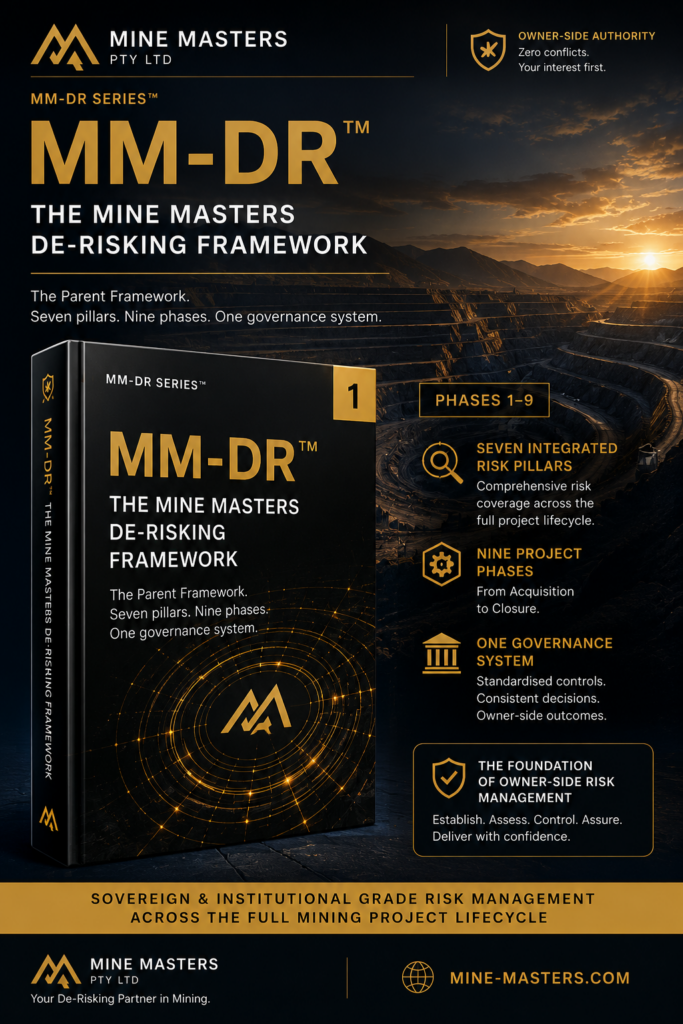
The Mine Masters De-Risking Framework is Volume 1 of the MM-DR Series — the foundational mining project risk management framework for owner-side governance across every phase of the mining project lifecycle. Seven integrated risk pillars. Nine project phases. The five-point risk rating scale and governance architecture that underpins all six volumes in the series.
This is not a reference guide. It is a working practitioner framework — built for the owners, MDs, GMs, CFOs, institutional investors, and senior practitioners who need decision-grade risk governance on active mining projects.
Download the free MM-DR Framework overview — a comprehensive introduction to the seven pillars and nine project phases at no cost.
What This Volume Covers
The mining project risk management framework is structured around seven integrated risk pillars — each active across all nine project phases with defined inputs, outputs, and handoff protocols between project gates.
Pillar 1 — Geological and Ore Body Risk Capital decisions built on orebody confidence, not assumption. Independent verification of resource and reserve estimates, Competent Person auditing, grade continuity assessment, and reconciliation risk assessment. Output: Geological Risk Rating.
Pillar 2 — Geotechnical and Ground Control Risk Ground behaviour managed before it becomes a safety event or a cost overrun. Rock mass classification review, ground support design audit, slope stability assessment, and Principal Hazard Management Plan adequacy review. Output: Geotechnical Risk Register.
Pillar 3 — Feasibility and Economic Risk Financial models that withstand independent scrutiny before capital is committed. Independent review of Scoping, Pre-Feasibility, and Definitive Feasibility Study documentation. OPEX and CAPEX benchmarking, sensitivity modelling, and production ramp-up credibility assessment. Output: Feasibility Assurance Certificate.
Pillar 4 — Regulatory, Compliance and Social Licence Risk (incl. Water Rights and Political Risk) Permitting, water rights, and political risk front-loaded so they never become a critical path constraint. Permitting pathway analysis, social licence assessment, Indigenous engagement protocols, water rights and water security assessment, and political and country risk assessment. Output: Regulatory Risk Register.
Pillar 5 — Operational Execution Risk The gap between a technically sound Definitive Feasibility Study and a producing mine is an execution gap. Mine planning review, equipment selection audit, workforce and roster design, production system assessment, and commissioning risk evaluation. Output: Operational Execution Risk Report.
Pillar 6 — Financial Governance and Capital Stewardship Risk (incl. Insurance and Risk Transfer) Capital deployed in accordance with approved scope with deviations escalated before they become material exposures. Project controls framework review, contract strategy assessment, independent cost monitoring, Owner’s Engineer function, and insurance and risk transfer register. Output: Capital Stewardship Report.
Pillar 7 — Environment, Rehabilitation and Legacy Risk (incl. ESG and Sustainability) Long-tail environmental liability quantified, funded, and progressively managed from day one. Environmental management system review, rehabilitation liability quantification, tailings storage facility risk assessment, and ESG baseline assessment against ICMM Principles and institutional investor requirements. Output: Environmental and Legacy Risk Register.
The Nine Project Phases
The mining project risk management framework is active across all nine project phases — each triggering specific pillars at defined intensity with a gate output instrument required before the next phase can open.
Phase 1 — Prospecting and Exploration Phase 2 — Scoping and Concept Phase 3 — Pre-Feasibility Study Phase 4 — Definitive Feasibility Study Phase 5 — Project Development and Construction Phase 6 — Commissioning and Ramp-Up Phase 7 — Planning and Production Phase 8 — Environment and Reclamation Phase 9 — Mine Closure
Every project gate is a risk decision point. No gate is passed without documented owner-side sign-off — creating an auditable mining risk management trail from exploration to closure.
The MM-DR Series
Volume 1 is the required foundation for all five subsidiary volumes in the MM-DR Series. Every subsidiary volume references MM-DR for risk philosophy, the seven pillars, and the five-point rating scale.
Volume 2 — Mining Acquisition and Due Diligence Framework Volume 3 — Mining Capital Finance and Market Compliance Framework Volume 4 — Mining Operational Readiness Framework Volume 5 — Mining Operations and Performance Governance Framework Volume 6 — Mine Closure Governance Framework
Apply This Framework With Mine Masters
“The most expensive advice in mining is the advice you did not get from your own side.”
The Mine Masters De-Risking Framework is designed to be self-applied by senior practitioners. It is also the foundation on which Mine Masters delivers owner-side advisory directly to project owners who need the framework implemented on their project — gate reviews, output instruments produced, and owner-side sign-off delivered.
Two paths. Same framework. Same standard.
Access Volume 1 — AUD $195 (Free Preview Available)
Access the Complete MM-DR Series — AUD $995